
Space & small discoveries · Published 18 October 2026
A galaxy on its side, with a star stealing the spotlight
At first glance it looks like a glittering streak. Look again and this Hubble image has a little lesson in cosmic perspective.
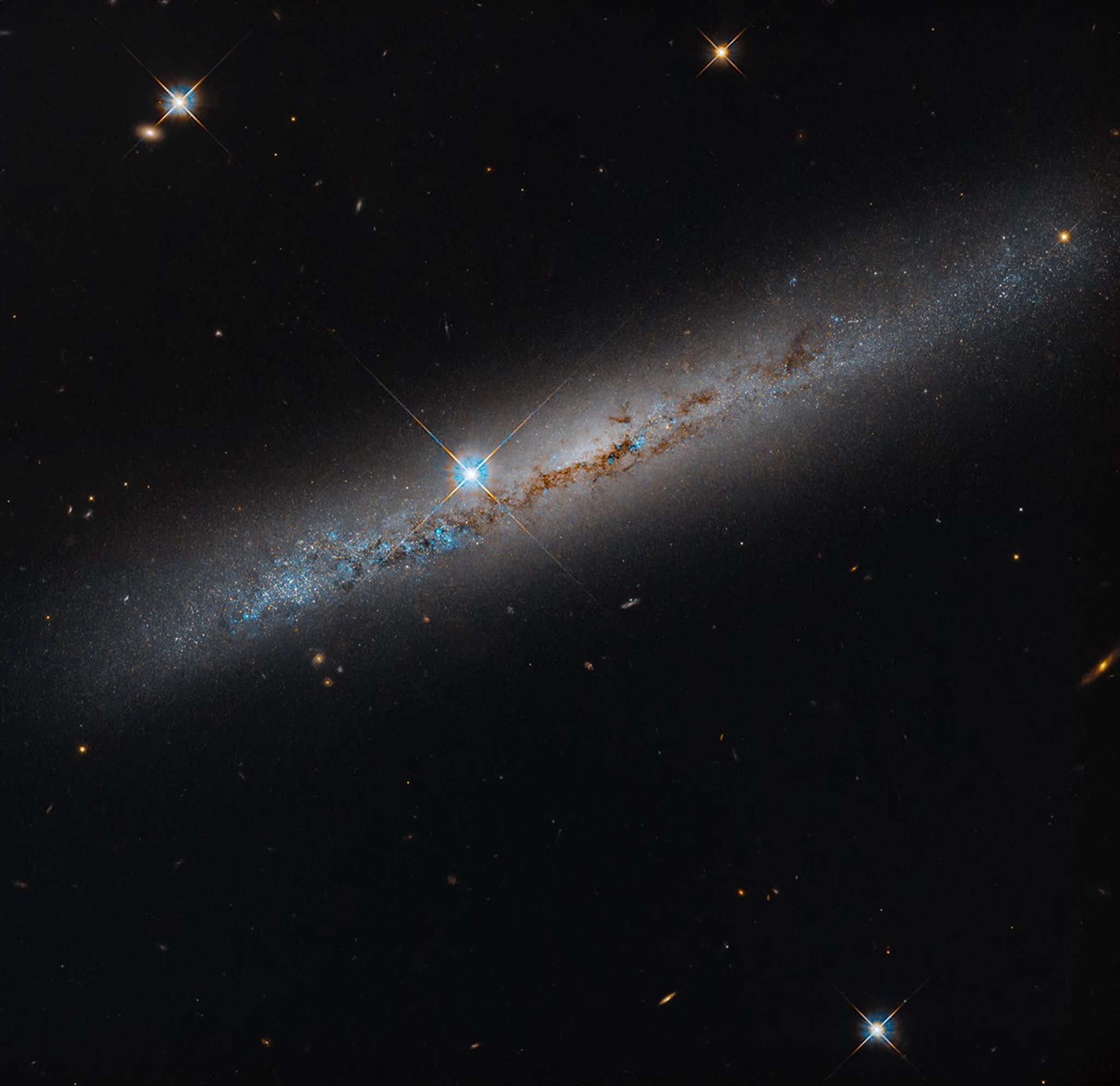
NASA's 16 October image feature introduces NGC 1827, a spiral galaxy seen almost edge-on, roughly 37 million light-years away. Its long strip of light makes a very different portrait from the neat pinwheel shape we might picture when someone says galaxy.
There is plenty to spot along that narrow view. Brown dust lanes run through the galaxy, while blue patches mark places where new stars are likely forming. Hubble's Advanced Camera for Surveys captured the observations behind this processed scientific image. It is a real telescope view, rather than an artist's imaginary scene.
The bright, spiky star near the middle is the picture's playful surprise: it is in the foreground, between us and the galaxy. Its four spikes come from light interacting with supports inside the telescope. Looking as though two objects share a neighbourhood does not mean they do.
Try a tiny tea-break challenge: find the foreground star, trace the dusty stripe and look for smaller galaxies in the dark background. There is no need to rush a picture that has so much distance tucked inside it.
Source: NASA Science, published 16 October 2026. Our perspective and gift suggestions are separate from the source reporting.